
By Noki Lam
Editor-in-chief
“Eternity,” released this past Thanksgiving, arrived as one of the most colorful movies in recent memory, rebelling against dark, desaturated color palettes that have been all too prominent in cinema’s recent years. However, the rom-com’s refreshing commitment to saturated hues, as well as its heartfelt ending, does not make up for the film’s hesitancy to fully explore deeper themes that the premise suggest.
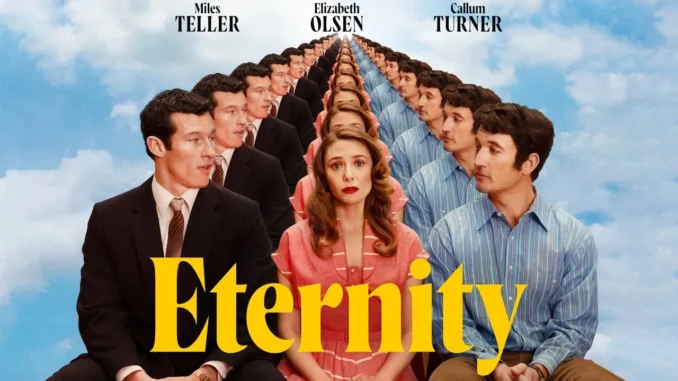
The film follows the afterlife manifestation of the recently deceased Joan, played by Elizabeth Olsen, as she reaches a halfway house. Depicted as a large train station with hotel components, it is meant to acclimate the living to the afterlife. This station allows the deceased to pick an “eternity,” a world molded into anything a person could dream of. The catch is that a person cannot switch eternities for the rest of time and will be punished with eternal darkness in the case that they are caught switching.
The situation quickly becomes even more turbulent than just the pressure of an eternal decision: Joan’s picture perfect first husband, who died in the Korean War 67 years prior (yes, there were 67 jokes in this movie, that frankly, were not very funny), played by Callum Turner, has been waiting for her at the station for a lifetime, refusing to choose an eternity without her. The conflict arises when Joan’s recently deceased second husband, played by Miles Teller, whom she has been married to since her first husband’s passing, also arrives at the station at around the same time as Joan. Joan must choose between her two lovers to decide who she will spend eternity with.
I came into the movie expecting an emphasis on the premise’s existentialist themes. The very concept of eternity demands intense philosophical weight. I anticipated the film to provide deeper meaning behind my understanding of what “forever” feels like and what people value when they are without the finality of life. Yet, “Eternity” consistently diverted attention away from the existential stakes at hand with romantic comedy beats. The film had an opportunity to confront heavy themes. Questions lingered about morality and the way people define paradise when imprisoned in that so-called “paradise” forever, or whether personal happiness should take precedence over the pain we inflict on others.
These themes, while quietly looming throughout the movie, were vastly overshadowed by lighthearted rom-com humor and interactions. The stakes of the plot made the choice of an eternity seem like a catastrophic reckoning with meaning and purpose, but the characters treated the situation like an adolescent romantic disagreement.
This cautious approach to such a heavy topic was not something I expected, given that the movie was produced by A24, a studio that has risen to the upper echelon of Hollywood by creating movies that venture into difficult moral and emotional themes. Therefore, I was surprised to be immersed in a film that side-stepped away from its complexities and opted for a predictable affair that missed the mark in delivering a philosophical message that lingers with the viewer. For those looking for a more easily consumable film, this could be a positive, but for merit in cinema, the execution of this plot is a negative.
On the bright side, the film’s world-building and system of an afterlife creates a believable framework that respects all religions and explains an imagining of an incredibly controversial philosophical topic through a masterfully crafted film. These concepts of ideologically perfect worlds make way for beautiful cinematography, including scenes in a beach eternity and a wilderness-themed world.
Ultimately, this movie was hurt by my expectations. It was not a bad film; it even could be seen as a good film. It just is no masterpiece. The movie definitely succeeds as a comfort movie and is a heartwarming depiction of humanity’s greatest fear. “Eternity” provides emotional satisfaction and is a representation of the pure enjoyment that movies can bring to an audience.

Leave a Reply