
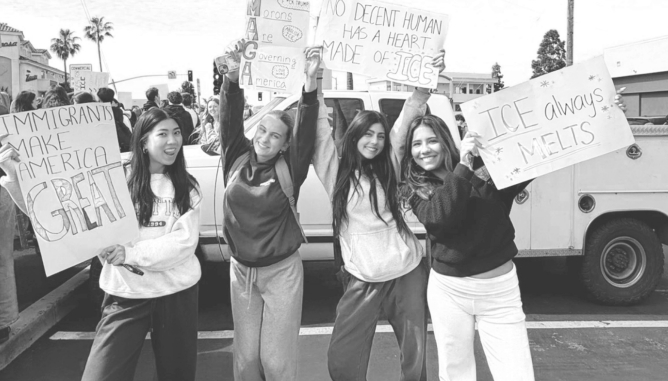
On Feb. 20, roughly 700 Costa students walked out during the passing period between third and fourth period and marched from the front gate to the intersection of Prospect Avenue and Sepulveda Boulevard in protest of recent Immigration and Customs Enforcement (ICE) actions.
The student-led demonstration, mainly organized by juniors Ruby Derenzis and Jonah Segil, was intended to show solidarity with immigrant communities both locally and nationwide. The idea originated from a conversation between Derenzis and Segil during the nationwide general strike and series of protests, which took place on January 30-31, feeling that Costa should’ve somehow participated.
“On the day of the national strike, we saw Redondo Union’s walkout and wondered why Costa wasn’t doing one,” said Derenzis. “So I reached out to Beach Cities Young Democrats (BCYD), a student-affiliated political organization that connects high schools in the South Bay, and they said that they’re doing a walkout and protest with multiple local schools on the 20th; and we just asked if Costa could join.”
After seeing large scale demonstrations at nearby schools such as Redondo Union, along with many broader national movements, many Costa students along with the organizers of this protest were motivated to want to take action.
“After we saw schools like Redondo Union have really successful walkouts and protests, and then also the national movement across schools throughout the country, we kind of felt like that had made an impact, and we wanted to be a part of that,” said Segil. “Also from seeing the recent events and aggression that ICE has done towards communities in the US, we really wanted to make a statement saying that that’s not ok in the Southbay and that we stand with the people in our community.”
Planning for the Costa walkout began the same time as the national strike. Derenzis emailed Principal Dr. Huynh the following morning to discuss whether a student-organized walkout would be permitted, and what steps would be required to make it happen.
“Jonah and I scheduled a meeting with Dr. Huynh after I emailed her, and we met in her office and just talked about the logistics of everything related to the walkout,” said Derenzis.
After meeting with administrators, the organizers worked to ensure students could participate without attendance penalties, referencing a state law that protects civic engagement.
“There’s a California law established a few years ago that gives one excused absence per year to any California student who is enabling their civic action, which covers a lot of things, and includes protests,” said Segil. “Dr. Huynh already knew about that law, so communicating with her was pretty easy, and we had no issue getting absences excused.”
Derenzis and Segil, along with other organizers senior Elizabeth Sherwood and sophomore Kathleen Obillo, all took on different responsibilities when planning the protest. Derenzis acted as the main point of contact with Dr. Huynh, Segil helped design informational posters and coordinate outreach, and Sherwood and Obillo helped publicize the event.
“It was a group effort, along with the help of a lot of other Costa students who helped with spreading the word by simply just talking about it and posting it on social media,” said Segil.
Because school announcements were not permitted, organizers relied heavily on personal social media accounts, word of mouth, and posters placed around campus.
“We were only allowed to use our own personal social media accounts to promote the walkout, because we were not allowed to make any school announcements over the loudspeaker or anything school-wide like that,” said Segil.
On the day of the protest, students met at the front gate before walking together toward the Prospect/Sepulveda intersection. The four main organizers brought megaphones and positioned themselves on each corner to help lead protesters and maintain structure. Everyone was encouraged to make and bring signs to amplify the protest’s message, and help clearly communicate their purpose to passing drivers.
“We told everyone to obviously not put any curse words on their signs, and that we’d aim to have it last around 30 minutes to an hour, then people could go home after,” said Derenzis.
For the organizers, the protest represented the importance of community gathering to spread awareness and convey a meaningful message, especially in a local setting where collective voices can influence broader conversations.
“I think most people think that because we’re high school students, we know nothing about this matter,” said Derenzis. “But I feel like being able to have our voices heard in events like this communicates that we actually know what’s going on in our community, and in our country, and that it’s important to us and affects us personally.”
The organizers viewed the walkout as an opportunity to highlight the potential influence of localized demonstrations, and the power of community-driven action.
“I hope that for people in the South Bay, this lets them know that the youth are extremely motivated and very passionate about making change and for standing up for the people in our community and across the country,” said Segil.
While California students are limited to just one excused civic absence per year, both Derenzis and Segil plan to remain involved in advocacy beyond this walkout.
“We have a voice, and we want it to be heard, and this is just one way for our voices to be heard in a safe way,” said Derenzis.

Leave a Reply